JPG to Text Converter – Extract Words from Photos Online
Use JPG to text to copy printed English from a photo or screenshot. Start with a sharp, straight image and review the extracted names, numbers and labels before copying them.
Drop an image here, paste it, or choose a file
JPG, PNG, WebP, GIF and BMP, under 25 MB. Printed English text reads best; handwriting is not supported. Your image never leaves this browser — nothing is uploaded.
Reading takes a few seconds the first time: the OCR engine loads in your browser (about 5 MB of English language data, cached afterwards). The image itself is never uploaded.
OCR is not perfect: check the text before you use it, especially numbers, names and punctuation. Faint, tilted or low-resolution text reads worst — a straight, sharp scan reads best.
How to Extract Text from an Image Online
Extracting text takes three quick steps: add your image, press “Extract text”, and copy or download the result. There is nothing to install and no account to create, and the tool works the same way on a phone as on a computer.
Prepare Input Files or Images
Click “Choose an image” to pick a file from your device, drag it onto the drop area, or copy an image and paste it straight into the page. JPG, PNG, WebP, GIF and BMP files are accepted, and each file must be under 25 MB. A straight, sharp scan of printed English text reads best — a tilted photo, faint print or low-resolution screenshot reads worst.
Choose Settings and Preview Changes
There are no settings to choose: the tool reads printed English text. The first run takes a few seconds while the OCR engine loads in your browser (about 5 MB of English language data, cached afterwards). The preview shows the image itself, and the recognised text appears in the box below it — you can edit the text there before you copy or download it.
Download and Verify the Output
Click “Copy text” to copy the result, or “Download as .txt” to save it as a plain-text file. The line under the text box shows how many words were found and the average confidence. Always read the result before you use it: OCR is not perfect, and numbers, names and punctuation are the first things it gets wrong.
Image to Text: What the OCR Reads and What It Cannot
The tool reads printed English text — typed pages, printed forms, screenshots of text, and photos of signs and notices. It does not read handwriting: handwritten words are recognised unreliably or not at all, and the tool never pretends otherwise. It reads one language only, English, because only the English language data is shipped with the tool. Text in other scripts is not recognised.
Recommended Default Settings
For the best result, start from the sharpest, straightest version of the image you have. If a photo reads badly, try a flat scan of the same page instead — and crop the image to the text first with the crop tool, so the OCR engine spends its effort on the words and not on the margins.
JPG to Text: Examples and When to Use It
Use OCR for a photographed page, a printed notice or a screenshot with text you can already read visually. Keep the source for checking uncertain lines.
Real Input and Output Example
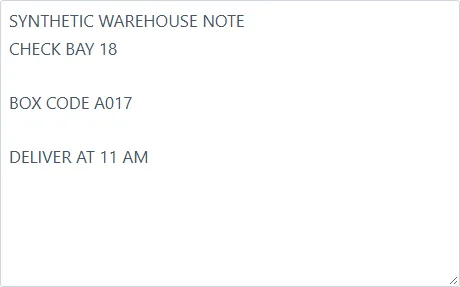
The synthetic warehouse-note example shows actual text recognized from a JPG. Check line breaks and compare similar characters such as the letter O and the number zero.
Supported Formats, File Sizes and Browser Limits
The tool accepts JPG, PNG, WebP, GIF and BMP uploads and exports plain text (.txt) or copies it to the clipboard. Individual files over 25 MB are rejected, and images over 8,192 pixels on a side are not supported. Very large images are read at their full size, which is slower — cropping to the text first is faster and usually more accurate.
Image Quality, Size and Compatibility Checks
Printed English usually reads better from a straight, high-contrast scan. Results vary by layout and source quality. Review the editable text before copying or downloading it.
Common Image to Text Problems and Fixes
Most OCR problems come from the source image. Text that comes out garbled is usually faint, tilted, low-resolution or photographed at an angle — re-scan it flat and straight. Words that come out joined together usually sit too close in a low-resolution image; a larger, sharper version separates them. Handwriting that comes out as nonsense is expected: this tool reads printed text only.
Troubleshooting Upload, Preview or Export Issues
A file that refuses to load is usually an unsupported type or a damaged file — the tool names the file in its error message. If the first run seems slow, the OCR engine is still loading (about 5 MB, once, then cached). If the download does not start, check that your browser is not blocking downloads from this site, then try again.
Related Tools and Next Steps
Image Converter, PDF to JPG, Crop and Resize Image, Remove Metadata.
Frequently Asked Questions About Image to Text
Mobile Support, File Privacy and Download Options
The OCR tool works in any modern mobile or desktop browser with JavaScript enabled: tap “Choose an image” to pick a photo from your phone, or drag a file in on a computer. Your images are processed locally and never uploaded, and they disappear when you close or refresh the page.
How do I turn a JPG into text?
Add the JPG photo, press “Extract text”, and copy the result or download it as a .txt file. The text is recognised in your browser with Tesseract.js OCR — the same engine this site already uses to detect text in photos. JPG, PNG, WebP, GIF and BMP images all work the same way.
Does it read handwriting?
No — it reads printed text only. Handwritten words are recognised unreliably or not at all. For handwriting, you need a tool built for it; this one will not pretend to read what it cannot.
Which languages are supported?
English only. Only the English language data is shipped with the tool, so text in other scripts is not recognised. If you need another language, say so — the language data is a separate download and would need to be added.
How accurate is the text extraction?
For a clean, straight scan of printed English text, typically every word, with an average confidence above 90%. Faint, tilted or low-resolution text reads worse. Always read the result before you use it — numbers, names and punctuation are the first things OCR gets wrong.
Are my images uploaded to a server?
No. OCR runs entirely in your browser using the vendored Tesseract.js engine. Your images are never sent to a server, never stored, and disappear when you close or refresh the page.
Choose the right portion of the image before OCR
For JPG to text, crop unrelated borders before recognition and use a straight, sharp image. Compare numbers, punctuation and similarly shaped letters in the result against the original. Treat the output as a draft for review.
Check line breaks after extracting text from a scan
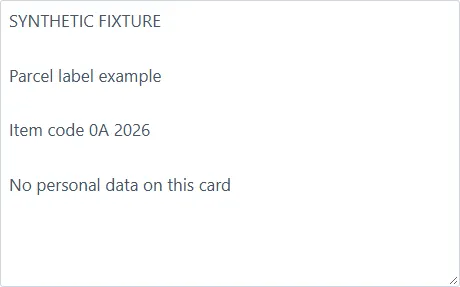
A column, table or narrow label can produce line breaks that differ from the scan. Paste the result into a plain text editor and compare each line with the original, especially dates, numbers and characters that look similar.
Microsoft explains the effect of scan quality on OCR and recommends proofreading.
Check similar digits and preserve the reading order in JPG to text
For two unrelated columns, crop one column first if the output reads across the gap. Compare ambiguous characters such as zero and the letter O. Keep the original image with any transcription where a reader needs to verify the numbers.