Pic Size Reducer – Reduce Image Size in KB Online Free
Use the pic size reducer to set a target in KB or pick an image quality level.
Drop images here, paste from clipboard, or choose files
Supports JPG, PNG, WebP, GIF, and BMP • Max 25 MB per file
Tip: You can also copy any picture to your clipboard and press Ctrl+V to paste
Reduce file size while keeping dimensions and pixel quality. Savings vary by image, and optimization may remove metadata.
Color optimization keeps the original dimensions. Colors and transparency can change. Choose Keep original pixels for pixel-for-pixel output.
The tool adjusts quality automatically to fit the size limit.
1 KB is 1,024 bytes and 1 MB is 1,048,576 bytes here.
All Processed Images
Files download separately in the displayed order.Start with the limit on your form, then preview the compressed photo and check the file size before saving. Processing happens in your browser.
How to Use the Pic Size Reducer for a File Limit
Reducing a photo's KB size is a trade-off between file size and visible quality. The tool below lets you choose the balance: set an exact target size in KB and it finds the best quality that fits, or pick a quality level yourself and see the resulting size before you download anything.
Prepare Input Files or Images
The compressor accepts JPG, PNG, WebP, GIF and BMP files, one at a time or several together. Each file can be up to 25 MB. Photos straight from a phone camera compress well; screenshots and graphics with flat colours and sharp text compress best as PNG or WebP at high quality, because JPEG can blur hard edges.
Choose Settings and Preview Changes
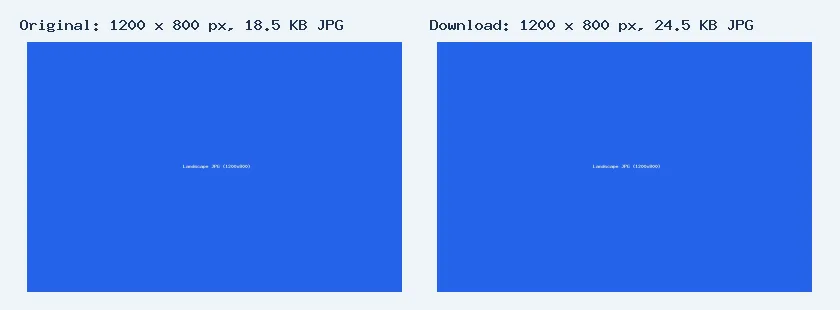
In target-size mode, type a size in KB — or tap a quick-pick button for 20, 50, 100 or 200 KB, or 1 MB — and the tool searches for the highest quality that fits. In quality mode, drag the quality slider and watch the size change. Every result shows the original size, the new size and the percentage saved, with a preview of the actual compressed image, so you can judge quality before downloading.
Download and Verify the Output
Click the download button under any result to save that file. The file name keeps your original name with "-compressed" added, so you can tell it apart from the source. Check the downloaded file's size in your file manager — it matches the size shown in the result, because the preview and the download are the same compressed file.
Pic Size Reducer: Target File Size and Quality Settings
Two settings decide the result: the mode and the format. Target-size mode is best when a form or upload limit names a KB number; quality mode is best when you want the smallest file that still looks good and no exact size is required.
Recommended Default Settings
For most photos, JPEG at 80% quality is a good starting point — it usually cuts a phone photo to a third of its size with no obvious change. If the result must fit a limit, use target-size mode instead of guessing: a 100 KB target suits most online forms, while 200 KB keeps noticeably more detail. Keep PNG only when you need transparency or perfectly crisp text, and remember that re-saving a PNG rarely shrinks it much — switching to JPEG or WebP is what saves the kilobytes.
Photo Size Reducer: Examples and When to Use It
People reduce photo sizes for the same few reasons: an upload form with a KB limit, an email attachment that must stay small, a web page that loads slowly, or a phone running out of space. In each case the goal is the same — the smallest file that still looks right for its job.
Real Input and Output Example
A typical phone photo of 3,000 × 2,000 pixels starts at around 1–2 MB as a JPEG. Compressed to a 100 KB target it usually lands just under 100 KB at roughly 60–75% quality, still sharp on a screen. The same photo at 200 KB keeps more fine detail, which matters for printing or zooming. Exact numbers depend on the photo itself — a busy, detailed scene compresses less than a plain sky — which is why the tool shows the real result instead of promising a fixed percentage.
For a 100 KB upload limit, start with that target in the pic size reducer and check the actual size of the downloaded file. If the format is fixed and the photo is still too large, try reducing its pixel dimensions before lowering quality again. For screens, check faces and small text at the size they will be viewed. The Canvas export reference explains why the quality control applies to lossy formats such as JPEG and WebP.
Supported Formats, Target KB and Image Quality Limits
The compressor works with the formats browsers can read: JPG, PNG, WebP, GIF and BMP. Results can be saved as JPG, PNG or WebP, or kept in the original format. GIF and BMP inputs are exported as PNG, because browsers cannot re-encode GIF or BMP files, and an animated GIF is compressed as a still image using its first frame.
Image Quality, Size and Compatibility Checks
Two honest limits apply. First, PNG is a lossless format, so re-encoding a PNG almost never shrinks it much; if a PNG must get smaller, convert it to JPEG or WebP instead — JPEG flattens transparency onto white, while WebP keeps it. Second, every photo has a floor: below a certain size there is not enough data left to describe the picture, so a very small target may be unreachable. When that happens the tool says so plainly, shows the smallest size it could reach, and explains what it changed — it never claims an exact size it did not achieve.
Common Pic Size Reducer Problems and Fixes
Most problems come from the file itself or from a single setting. A file that will not load is usually an unsupported type, a damaged file, or larger than the 25 MB limit — the tool names the file and says what is wrong.
Troubleshooting Upload, Preview or Export Issues
If the result looks blurry, the target was too small for the photo's detail — raise the target or the quality and compare the previews. If a PNG barely shrinks, switch the format to JPEG or WebP. If the download does not start, check that your browser allows downloads from this site, then try the download button again. If the page feels slow with many large photos, compress fewer files at a time: every image is processed in your browser's memory.
Frequently Asked Questions About Pic Size Reducer
How do I reduce a photo to a specific KB size?
Choose target-size mode, type the size in KB — or tap a quick-pick button for 20, 50, 100 or 200 KB, or 1 MB — then add your photo. The tool searches for the highest quality that fits under your target and shows the exact resulting size. If the target cannot be reached, it says so and shows the smallest size it could achieve.
Will reducing the KB size make my photo blurry?
It can, if the target is very small for the photo's detail. Moderate targets such as 100–200 KB usually look fine on screen. The preview shows the actual compressed image, so check it before downloading — if it looks soft, raise the target or switch to quality mode and pick a higher quality.
Can I reduce the size of several photos at once?
Yes. Add as many images as you like and they are all compressed with the same settings. Each result has its own preview, sizes and download button. The tool does not create a ZIP archive, so files are downloaded one at a time.
Are my photos uploaded to a server?
No. Compression happens entirely in your browser using the Canvas API. Your images are never sent to a server, never stored, and disappear when you close or refresh the page.
Why can't my photo reach 20 KB?
Every photo has a minimum size set by its detail: a busy, high-resolution photo simply needs more bytes than a plain one. The tool first lowers quality, then reduces dimensions step by step, and if even the smallest version is over 20 KB it shows the best size it reached and explains why — it never fakes the number.
What to do when a photo is close to the KB limit
Check the form’s accepted format and minimum dimensions before using the pic size reducer. If the form requires 100 KB or less, leave a small margin instead of aiming for the last byte. Inspect the downloaded file size and open the image to check small writing, edges and faces. If lowering quality makes them hard to read, crop excess background or reduce the pixel dimensions before exporting again.
A pic size reducer can change the file size without changing the image dimensions if the selected format offers a quality setting. If the photo contains small print, inspect that area rather than judging by the entire thumbnail.
Check whether your form counts KB or KiB
A 100 KB budget may mean 100,000 bytes or 102,400 bytes, depending on the service. Leave a margin when the reported size is close to the cut-off. The pic size reducer preview helps you compare quality, but the receiving service decides whether it accepts the saved file.